Scroll down for my Story



Tractors I have owned
My first recollection of a tractor was on a w30 McCormick Deering . My father was discing near our home and left me steering to go for a cup of tea .It would have been during the second world war toward the end of that 39-45 conflict as tractors were still scarce and this one was on rubber tires from a used air force bomber. The tyres were diamond pattern and were ok when things were dry but pretty useless when it became wet as far as gripping was concerned . Coming to the first corner and driving with the right front wheel in the furrow of the previous round the steering locked up in full turn and with all my strength I could not straighten up . The tractor proceeded out of the furrow and prescribed a circle and continued to go round and round digging a deeper and deeper furrow. I can not remember why I did not stop this futile venture but maybe my legs were too short to disengage the clutch and the mind boggles in this day of h and s and how my dad would have been able to climb aboard a moving machine to stop the situation.
I am reminded of some of the fool things I have done over the 50 years of active farming.
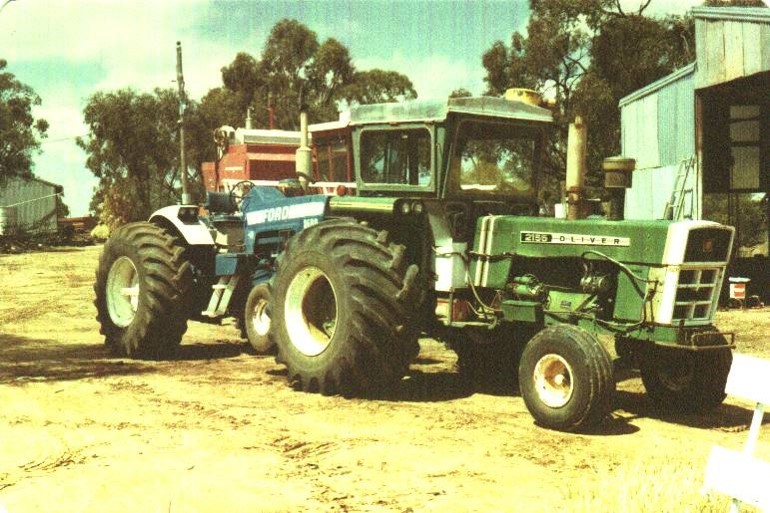
Things that get the adrenalin running . I have worked two sets of tractors in tandem for many years . I had a International 554 in tandem behind a t model T lanz bulldog for a period of six years. Later I had a Ford 8000 behind a big Oliver 2155 complete with hydraulic clutch control and bowden cable gear and throttle control . These tractor sets could be split in five minutes to conventional configuration and were a cheap way to get more power and get the job done quicker .
These tandem set ups could get rather complicated owing to the fact that that with two tractors one could pull two implements . I used to pull two scarifiers for cultivation and and also two combine seeders for seeding with these rigs and that required a tandem hitch set up. We had a farm we leased 16 miles from home and that meant travelling with all this gear on the roads to get there . I would have my tractors in tandem setup the two machines and the folded tandem hitch plus my holden FJ ute and fuel cart all in line , 7 machines and articulation points .It would take some time to get everything lined up to work in field mode. This resulted in my design for a folding tandem hitch that would simply move from road mode to field mode very quickly and efficiently. Interest was such in this machine,s that we obtained a patent for it and eventualy two companies ,one in Victoria and one in South Australia began manufacturing these tandem hitches.
This hitch was unique enough to protect with a patent and this was an interesting adventure, Hiring a patent attornee and doing the drawings and text documention to go with it . How wide to protect it nationally or international and the costs involved . It all was a steep learning curve and in the end the only remuneration was the experience
Before the folding hitch I experimented with two conventional tractor and machine units with the rear unit automatically following the first unit.
This required a telescopic steering arm connected to the rear of the front machine and leading and steering the rear tractor. I developed an automatic throttle control that controlled the speed of the rear tractor by placing an inclined plane on the telescopic arm that opened the speed control on the rear tractor as the front one moved forward. When the front tractor stopped or slowed down the speed of the rear one would drop to compensate and if the front tractor stopped the rear tractor would continue forward until it hit the end of the control plane and a hydraulic master and slave would disengage the tractor clutch.
This system worked well on good going on conventional cultivating but on the corners the rear tractor would stop and disengage the clutch because of the shorter radius of the turn.
One time When testing the system in the farm yard the steering arm came adrift and the rear tractor took off at full speed across the farm yard. That’s when one gets an adrenalin rush and becomes exceptionally acrobatic. That’s when I designed the folding hitch where we had much better control.
I was born in 39 right at the start of the war and was raised early in very tough times .
It was not very wet through all that period as it was the dry 40,s and all the old farmers talk about that difficult period. It must have been earlier in that time that I remember the dust storm that created a complete blackout because I was in the kitchen at home with my mum and I remember walking into the table face first as it became pitch black and my mum walking into a closed door that had blown shut in the accompaning wind surge. And then as the change went through and light began to return the roosters crowing at 3 pm in the afternoon as they thought it was new day
My Uncle and Father just out of age range for the military call up were required to grow food for the war effort and that’s when the transition to tractors exploded . Because of the drought the draft horses were sent away to the Western District on agistment and did not come back. Tractors were extremely scarce and the available ones were balloted out to the farmers and I don,t think there was a choice of what colour you got . Our family ended up with a red McCormick Deering W9 Kerosene tractor . The neighbours a Yellow Twin City U model Minneapolis Moline and other neighbours a Massey Harris also red . These were US tractors . I remember in the mid 40,s that W9 was worked around the clock during seeding to get the crop in including a neighbouring farm . Early on they did not even have electric lighting relying on a kerosene hurricane lamp tied to the front to see the way. I used to love the smell of hot kerosene . These tractors were started on petrol and the fuel system was such that the kerosene had to be preheated before it would vaporise in the engine . When the engine was sufficiently warm the Kero was turned on
Soon after the war German tractors became available again . The Lanz bulldog was one such . These were two stroke single cylinder diesel tractors . They needed a petrol blow lamp to heat the combustion ‘Hot Bowl’ to get a start. These were rugged very economical tractors that would run on low grade crude oil. My dad and uncle split up the farm about this time and Dad inherited the Bulldog and Uncle Bill kept the W9. We had some troubles with this tractor mainly because of the sandy soils and gritty dust we had to deal with . The fuel pump and governor setup was very simple but was very prone to wear. We could not keep the dust out of the eccentric drive for the fuel pump plunger and the governor was always giving us trouble . It had two speeds Idle and flat out.
Father was not a good mechanic having been raised with Horses . They did have a Chevrolet truck and his first car a 27 dodge he bought new and this car is still in the family completely restored by my brother John for His daughters wedding. I remember going to Melbourne in that with dad in the 40’s and it took 6 hours . The Marong Bendigo bypass was unmade and had a stone ford for the creek crossing.
What he lacked in expertise he made up with perseverance and an incredible can do attitude that I reckon has rubbed of on the family. He did get himself into some major scrapes that were not all his own fault I saw him once when I was very small sling a 7 ft southern cross windmill cast Iron head over his shoulder climb up the windmill and drop it in place . Health and safety not an issue.
One time the Bulldog blow lamp began leaking petrol and of course started to burn where it should not have . Rather than shutting it down and smothering it with sand he thought it was just a little loose on a fitting . He took a pair of Multigrip pliers to it to tighten where it was leaking and burning only to screw of a sweated join and so the whole lamp blew up in his face . He had many weeks in hospital over that with severe burns to his arms and face but eventually recovered well from that experience.
Harry , the big cockney tractor expert that used to service the tractor and keep it going told dad about a new invention for starting Bulldogs called a electric, petrol starting system. This was a great idea in theory and I think mum persuaded him that anything would be better than a petrol blowlamp so we got one of these fitted along with a generator and battery and some electric lights..
Well it did not work all that well . It had a T model Ford continuous spark coil and a huge spark plug fitted into a plug on the cylinder head . A small petrol tank also went on and a two way tap. The starting mixture was half petrol and half diesel mixed. The idea was the spark was turned on then several pumps of the starting mixture was introduced and the flywheel was given a good hard rock with a handwheel against the compression as you would do normally with the blow lamp start and if you were lucky the engine would start with some loud detonations and you would be in business .about half the time the engine would start backwards and there was a trick in shutting down to the last revolution and pump at exactly the right time and the engine would fire up the right way. Well it was always exciting getting a start with this gear on a cold morning
. One frosty morning it refused to start altogether so out came the blowlamp . we were milking a couple of cow,s with one of my siblings up the other end of the shed.
Father got the blowlamp going pretty well under the hot bowl and was about ready for a conventional start . The bowl would start to glow red and there would be some hint of fumes from the exhaust. Next without any human movement the was a great detonation and woosh of flame shot out of the exhaust and a sheet of iron directly over the exhaust was blown clean off the shed.
My cow put its foot in the bucket and we always had trouble after that getting those cows to bale up.
Evidendly the hot bowl must have been half full of petrol and totally flooded . We went back to the conventional blowlamp after that.
Economically things started to improve and the early 50 , s were wet years and good crops and prices . Most farmers upgraded after the 53 wool boom when wool hit the proverbial a pound a pound . Father bought a new truck and a car . A Ford Thames truck which was a lemon and a Customline that was a beautiful motor car. They both had v8 side valve engines but the truck had a English ford Pilot motor that was a very poor engine . The car had a mercury US engine that was very good . The Thames had a solex cabureter that had a vacuum operated accelorator pump and unless the carby was full of fuel it would never start. . WE ended up putting an electric pump on it that fixed the starting problem but it would be always burning valves . I got that way I once did a valve job half way to town with a load of wheat .These engines had a unique valve mechanism with split collettes and springs held in place with a clip.
All one had to do to get a valve out was take of one of the cylinder heads, and the valley cover and using a special ford valve tool, lever the offending mechanism., slip off the clip and the whole thing would just pop out and reassembley was just as simple. The valve lash was easy . Just flat grind the end of the valve to get the proper clearance. Another unique thing about these engines was that some of them shared a bigend bearing with a connecting rod from the cylinder on the other side as they shared the same crank journel anyway. I think this was the cause of the demise of many of these ford pilot engines as they were prone to spin big end bearings and so cut off the oil supply.
I have struck this problem of spinning bearing,s a few times in my years of farming . An engine can be running very well but as wear begins on the bearings the little tongs that keep the slippers in place begin to wear and eventually will allow the bearings to turn with the crankshaft and so cut off the oil supply to a journel. It has happened twice to me when the engine was idling . It happened on my Oliver 2155 just before Easter one cropping time . This tractor was not even burning oil and was running perfectly and it suddenly seized up. It was panic stations as it was my main tractor at the time . I have found service people will bend over backward to help in these time,s as we had to coordinate the people who grind crankshafts . Parts suppliers from Interstate , usually Sydney and arrange overnight freight . It all worked well that time.
Exactly the same thing happened with a 711 International Australian header some time before. We were standing beside this machine having just unloaded and the machine was idling quietly and it suddenly tightened up, blew some smoke and stopped, siezed.
That time we installed a complete new engine, again the service people at Ryans in Charlton bent over backwards to get us going.
Another time we did the same thing on my International 915 header. Just getting into harvest in a time when contract harvesting had hardly began and we are on our own. . We had that motor out and at the local service center next morning. They laid the engine on its side . never even took the heads off. We located a reconditioned crankshaft in Corawa NSW . A neighbour with a Cessna aircraft kindly obliged to fly to Corawa for me as long as I took his place in a shearing shed while he did it. .He was having a sheep flystrike problem, .All the parts arrived overnight and the team at Dunlop Isbell in St Arnaud were already to start reassembly on the Saturday morning. We had the header going midday Monday and we don,t work Sundays. That engine is still running five years later.
Back to the fifties
Some of the neighbours were getting hydraulic systems fitted to their tractors and that was better than sliced bread.for me. In the 50,s it was wet especially 1956
and we were constantly getting bogged and this entailed in those days,in hand winching the cultivating and seeding machinery in and out of the soil as wet spots came up. A very physical and tiring job . no sooner were you out of one wet spot you would be winding furiously to get it back in the soil and you would have to start winding out for another wet spot.
With a remote hydraulic cylinder all one had to do was operate a small lever valve and watch it do all the work.
Well we set the old bulldog up with a fancy set of Beecraft Hydraulics bolted on to the mudguard and driven with three v belts from a pulley on the protruding crankshaft. No covers of course all out in the open and it was just magic
Harvesting in those days was mostly done with a Power Take Off (PTO) towed behind harvester. This required two drivers one on the tractor and one on the harvester to operate the height of cutting and do the adjustments on the harvester.
The year I left school at 14 . I took the harvest off with a friend from Melbourne who drove the tractor. The hard work was lifting the filled three bushel 180 lb bags from the harvester box and standing them in rows ready for my Dad in the truck to pick them up.
Some farmers had an extension steering mechanism so they could steer the tractor from the harvester seat. Fred, our neighbour had a setup like this and one day as he was concentrating on the harvester on the first round of the paddock he felt the machine lurch and looked up to find the tractor had moved to the left and was proceeding through the fence into the next paddock.
As a reward for the all the hard work my father allowed us to have a holiday in Brisbane staying with an Uncle and he also allowed us to fly there . It was on a DC3 airliner . A fantastic aircraft held together with a million rivets and we chose to stop at as many landings as possible . I think there were five from Essendon to Albury, Sydney, Coff’s Harbour, Coolangatta and finally to Brisbane.
The new hydraulic setup on the tractor allowed us to run the harvester from the tractor which was a much more efficient method and one man could do the job easily.
Bulk handling grain was developing in the 50s and Australia was behind the US and Canada in this development .
The majority of harvesting at that period was done with tow behind PTO harvesters and stripper type harvesters such as the very popular Sunshine harvester AL Model .
Stripper harvesters differed from the cutterbar sickle knife type headers as used in the Northern hemisphere exclusively at that time and all the self propelled Combine type harvesters . The AL was a very simple machine and the heads of Grain were beaten off the straw as it was driven through the crop leaving most of the straw behind and heads were substantially threshed right there at the front, the material was then partly blown with the effect of the front beaters and a belted slat elevator belt to the peg drum and then to the sieves (Riddles we called them) and gravity fed into a double cup elevator , one side for the clean grain and the other side for the tailings to return to be rethreshed . The crops in Australia at that time generally stood up well and in the Wimmera Mallee did not lodge too badly and were able to be managed with this machine .
These machines only had small grain bins arround ¾ tonne or 7 *3 bushell bags and when it came to bulk handling, the side trailor was developed that could carry over 3 tonne and had a PTO auger for unloading . It was towed beside the harvester and I guess it was the forerunner of the Chaser bin of today.
Again many accidents occurred with loose clothing catching in exposed PTO shafts . To unload these trailor bins the PTO was disconnected to the harvester and the shafts were swapped to the unloading auger.
My cousin, Alan got caught and was left in his singlet and Socks only with much bruising as all his clothes were ripped off . He survived that one.
Years before his father had his pants ripped off by a PTO bag loader . This was a machine designed to lift open top bags of wheat up to tray level on a flat top truck . It was an ingenius invention driven from the gearbox of the truck via shafts and universal joints all uncovered with a dog clutch to engage the lift when a bag was placed ready to lift.
In contrast the early US pto machines had high bins that could be emptied by gravity into a truck bin (Case) and I saw in Canada at a heritage park in Calgary a virtual train of small steel wheeled bulk grain wagons dating back to the 1930 s era.
At Home we made the decision to purchase a used self Propelled header rather than continue on the PTO path. It was a used English Massey 726 with a twelve foot front and a bin that held about two tonnes .
The engine was a petrol 6 cylinder Austin placed low under the threshing drum . Right down in the straw and dust and had to be watched like a hawk for fires.
It had small capacity but could handle heavy crop if taken slowly and it got us into bulk handling. This was well built machine and had roller bearing,s on most shafts and it had an electric lift mechanism for the front that worked very well . IT had a very simple engaging clutch which worked on variable speed pulleys that could be released by a lever that opened the pulleys to allow the belts to slip and disengage that not only acted as a clutch but also the variable speed drive needed for harvesting .
Because there were few sp headers in the district I was often called to open up a paddock IE Do the first round so the PTO harvest tractor did not need to roll over new crop . One time I was opening a paddock on a steep Hill, made the mistake of pulling the clutch lever back so far as to disconnect the drive and the header took off downhill . The brakes were not good .
After the Massey we purchased a Massey Ferguson Australian made 585 ,15foot front also petrol driven but with the Chrysler 6 cylinder petrol,side valve mounted up top behind the grain tank . This was very a good little header and we drove it for many years .
We then doubled up with a Used PTO A86 16 ft that we used for a couple of years behind the Oliver tractor
We then lashed out and purchased a new International Australian made 711 model with a 16ft front . Initially we had a lot of trouble with this machine and it was poorly put together on a Friday afternoon we reckon . We could not keep the fingers from getting loose and falling off until we found the mounting plate had a taper on one end and had to be replaced eventually under warranty . We also had trouble with the elevators that had faulty sprockets. We had this machine for many years and wore it totaly out .
Brother Neil and I in the early 80s leased some more land and we purchased a Massey Ferguson 5500 20ft PTO . We split up after this and Neil took the 5500 massey.
Our next header was an imported International 915 . Conventional type header with a 24ft front . WE had lots of trouble with this one especially the machine drive clutch and it had a unique fan cleaning system that would never give us enough cleaning air .
They were the last of the conventional drum type combine harvesters made by IH . On my farm study tour of the US and Canada in August 1977 They showed us their new axial flow 1660 harvest that had just been released .
This was the first single cylinder axial flow machine . New Holland had a twin rotor machine from 1975 and later in the 70,s Allis Chalmers introduced their n5 rotary type machine , John Deeres did not have rotary till much later .
Neil and I enlarged our workshop and started to do some modifications to Machines to suit our farm systems.
Neil or George as we know him . (all of us had nicknames from our Father) built a silo bin in front of our shop one winter in the mud and slush and a welder that had very worn and leaky rubber leads and as the leads were laying on wet ground everything metal in the vicinity was prone to electric shocks ,
He then built his own tractor out of a general Grant Army tank transmission and an old road grader , He was only 20 at this time and with little equipment lines it all up by eye . He ran that rig for ten years and got himself into farming .
He was the youngest in the family of five . Our two brothers in the middle Bruce and John eventually ended up in Melbourne . Bruce got an apprenticeship with the telephone company on the technical side and John went and boarded with Him and found a position as an engineering student at Brighton Tech . I think He was only 14.
John got through to tertiery level and became a mechanical Engineer ending up with Nestle in Cairo for five years and in the head Office in Switerland to cap his career
Our farm was small only 1000 acres of mainly light and sandy soils and we did not make much headway in the very wet years of the fifties were the soil became waterlogged and the natural fertility became run down and the sloping land eroded .
We found the introduction of legumes grasses like barrel clover did not like our acid type soils but we were successful with subclovers and then found Lupin crops were the key to building fertility. Our first break came when we were able to lease a farm to the west on heavier soil west of Lake Buloke . We leased this farm for 19 years and it worked well with the home farm as they were pretty good years in the 60s and 70s
Our workshop was the catalyst for our engineering exploits and most farm improvements were the result of Mechanical leaning farmers improving or fixing machines to work better .
Brother John as mentioned was able to graduate in Mechanical engineering and set the tone for all the family and George has built many machines after his initial tractor building exploits going on to build his own airseeder and self propelled boomspray and then to even building his own House along with all His farm shedding .
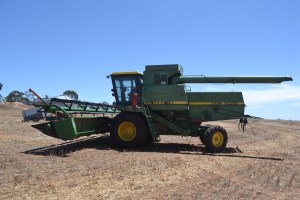
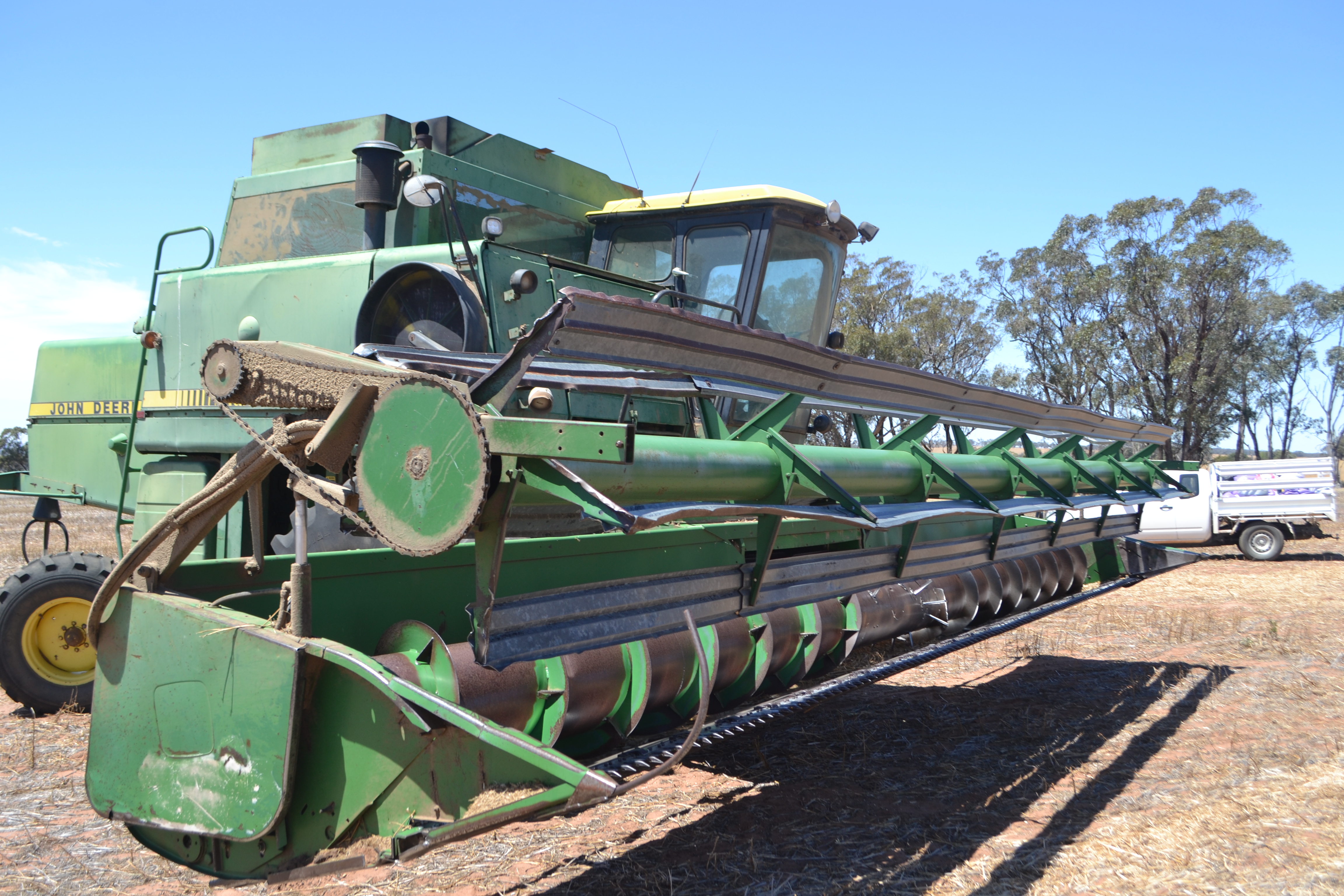
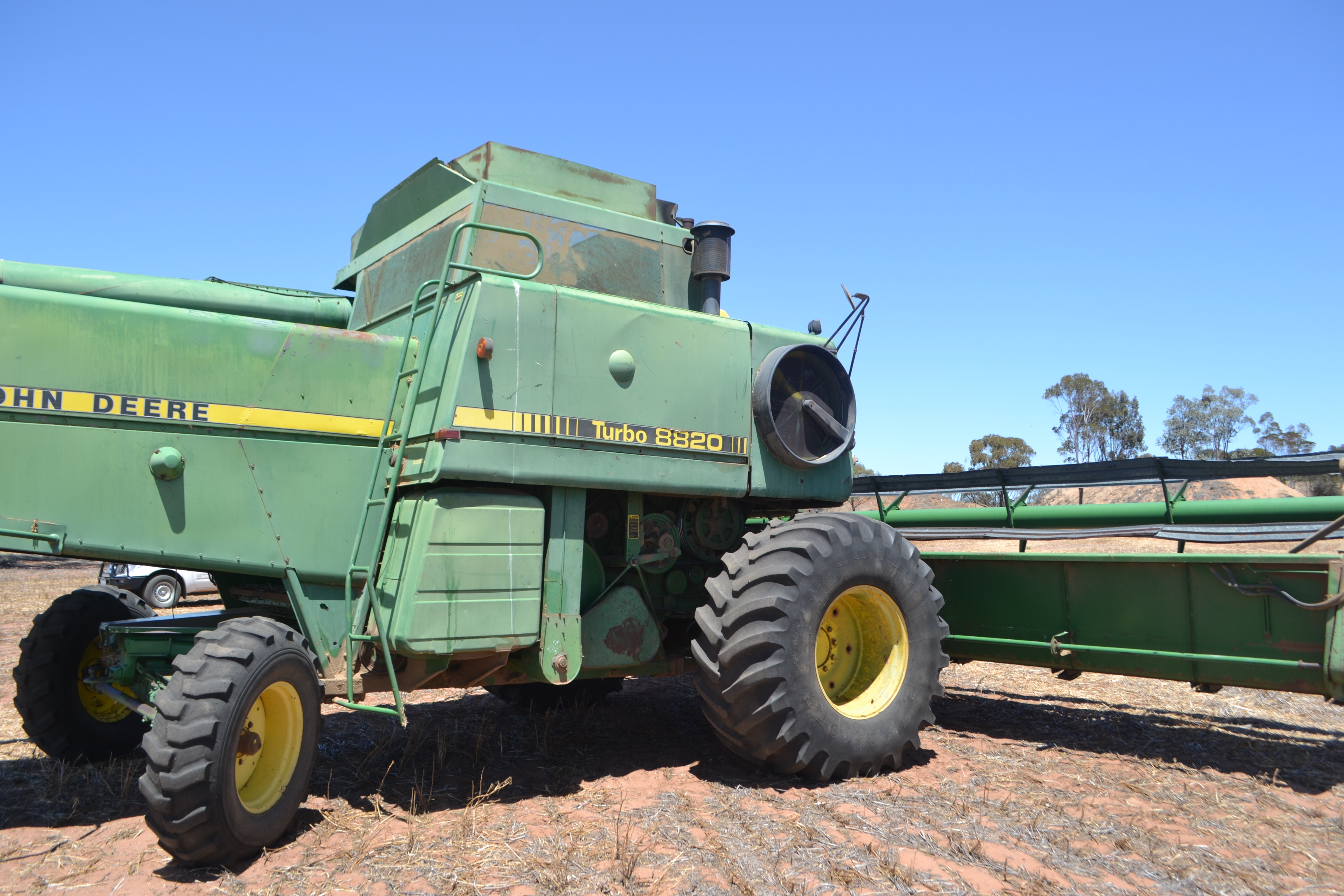
On my side we built over the years things like a 21 foot windrowing attachment for the headers . Initially on the 711 IH and with mods to the 915 case and finally on to the 8820 John Deere.
We got into airseeding early with a prototype Shearer Airsseeder that we used for many years or I should say put up with it as it was a very poor machine with not enough air and very difficult to clean out . we could not sow Canola with this machine as the small seeds were to difficult to calibrate .
This resulted in our building a mini airseeder just for canola and small seeds and we used that for some years . Often spreading the seed in front of a prickle rolling chain that George and I developed from Scratch.
Our twin boys .different as chalk and cheese have both ended up in engineering Robbie through the academic path into the oil industry and now retailing Natural Gas . Jim by the seat of his pants always the practical one did his Farm apprenticeship with me with a spanner always in his pocket got into hydraulic engineering through trying to develop a bale stacking machine on the farm only to run into problems with the digital hydraulic controls and systems that were emerging and available with little guidance on how it all worked .
Through this experience Jim has been able to master the trade and has become an expert in Hydraulic systems and problem solving on a National scale with a German Based company .
Tractor Cabins
Most of my farming was done out in the open Hail or shine .Freezing or stinking hot .
We had umbrellas and hessian sun covers on the headers but it was not until we started this 24/7 stuff when Neil joined me and we started pushing from both ends and had the tractors in tandem and broke some new ground behind the Lake that I decided to put an old truck Ford f600 cab on the bulldog . This worked pretty well but it was very noisy but we were able to divert the radiator heat back into the cab which made the frosty nights a lot more comfortable .
The big Oliver 2155 came without a cab so I decided to build one with an eye on dustproofing .Noise reduction and air conditioning. I had read that most noise problems come from echoing and bounce from opposite surfaces so I desighned my cab with no two surfaces directly opposite and with full insulation was successful .
Ths tractor had a quiet diff with planetaries in the wheels .
I had some aluminium sheeting that was lovely to work with and had the windows custom made and fitted the biggest automotive air /con I could get with doubled up condensors worked very well .
The big weakness on this tractor was the steering mechanism so we ended up throughing it off and put power steering from a truck on it and we had no more trouble .
Power steering on tractors and trucks was also a big energy saver and made it easier and safer to operate heavier equipment.
I had built a bulldozer blade on my T model Bulldog initially to help fill washaways on some sloping land we had.
The dozer worked well with a hydraulic ram fitted but it was very difficult to steer and the steering wheels would catch a rut or gutter and almost break ones hand in the effort to hold it.
I decided to build my own power steering for this tractor using a steering ram off a truck and using the oil flow from the remote hydraulics. I figured I could use a normal two-way control valve by taking out the balance springs and mounting it directly on the steering arm. I found we immediately had 100% fingertip power steering and no kickback. It worked so well I was able to do the same thing much later on my Oliver 55 that also had very poor steering.
The T model Lanz hydraulics initially were not live, being driven from a shaft in the gearbox. When the clutch was disengaged, we had no hydraulics. This made it almost impossible to operate a dozer blade so I figured a modification to the drive taking a roller chain directly from the engine crankshaft to the hydraulic pump and this made all the difference also allowing power steering to work.
It has been the best of times we lived through. The 60.s and 70’s were great years.
The Wimmera Mallee traditionally has experienced a drought year probably one in ten and the only real drought in the period was 1967.
It was the year our twins were born, and the only year I went away shearing.
We never really had any sideline pursuits like vege gardens or even eggs or dairy cream production etc. as my parents had. I figured my sideline was shearing and along with my mate, Geoff Postlethwaite from Canooer Bridge we shore for 30 years or so and did some of our neighbours over the years.
My main interest was the land, crops and sheep and my workshop.
After the experience of working in the mud and slush in front of our small shed, I built a purpose built shop with a concrete floor. A saw tooth roof with plenty of natural light and a service pit along with an overhead hoist to exchange engines on vehicles.
We eventually purchased a big old Macson, flat bed lathe and taught ourselves turning and machining skills even to making and threading our own large bolts.
The 80,s were notable for the worst drought we had ever had in 1982. From the 50,s right through to the 82 drought we had experienced good spring rains enabling us to grow legume crops such as peas and lupins. The springs have not been as good since I figure and many legume crops have failed due to dry springs although we have been able, with new technology low until farming and the use of natural gypsum, to grow good cereals and even oil seed crops such as Canola.
Reflections
As I approach the four score year, I reflect on my life here in Southern Australia.
I am a 39 model. The year the Second World War started.
No sooner over the depression years of the 30s when life was so difficult. I was the firstborn om my parents who had waited 7 years to be able to get married because of the extreme hardship caused mainly by the economic circumstances
I am the 4th generation of the family here and although the extended family had done, very well after settlement my Grandfather had a poor start living on my Grandmothers Jackson farm at Granite where they ran the post office.
My Dad and Uncle Bill were working together at the time and they bought land at Banyenong which had previously been a Sellick holding in the Pine and lunette sandy rises. My Father John built a new house there in 1937 and that has been my home for
65 years.
James and his wife Grace came back to farm and purchased the Farm Home Block and infrastructure in 2004 and we built our Home in Sproats Lane on the river in Donald.
The farmhouse was a Coltmon Kit home from Ballarat, originally just 4 rooms with a veranda all around .It had two chimneys one in the kitchen for the stove and an open fireplace in the lounge room .
The House of weatherboard construction on local Grey Box stumps has been added to substantially over the years. As my four siblings, three brothers and one Girl arrived. My Sister Beryl (Bub) arrived after me and then Bruce (Jack) and John and lastly Neil or George. We all had nicknames from my Dad except for his namesake John.
The verandas were filled in as sleepouts especially in the summer with fly wire screening, The canvas blinds initially and then louvre windows were installed.
An extra room was added about 1956 and an outside bungalow to house the growing family.
Economically things improved dramatically after the war and the wool boom in the early fifties and the controlled marketing of wheat saw prosperous times again.
On our farm we missed out to an extent in the very wet years of the fifties as our land became waterlogged and lost most its natural nitrogen.
The introduction of Gypsum was a life changer on the red clays and windblown sandy areas. We also had major water erosion on our sloping hill country and when I left school in 1954, we had gutters nine foot deep and much sheet erosion from the effects of the drought years when the wind blew much of the top soil away. The farm only had horses in the 30,s and they had to be sent away on agistment to the western District and so the farm had nothing to ridge the paddocks to stop the wind erosion. Our close neighbour the Jack Pinks had a problem when the blowing soil built up to the roof of the horse stables and a draft horse found himself on the roof and fell through the thatched roof with his legs straddling the roof purlins, which had to be cut to release him.
Back to my childhood days and growing up with my three brothers and sister.
We did not have much in the way of toys during the war years.
We played at farming and made our own little farms in the sandy soil .Made our own tractors and machinery out of tin from old jam tins and scrap wood and unravelled chicken wire. We made wheels by slicing of old broom and broken shovel handles.
School
The Jeffcoth Sth School was in danger of closing and I was four and a half so I was sent here for part of its last year. I remember the Dunstan twins Ian and Brian were there along with Jo Dixon and not sure one of the Nolans. It was about 3 miles from home, I used to walk partway home up the back road, and Mum would meet me in the old Dodge car. I remember we pinched some gravel from the road (Charlton Road) which then was gravel anyway, to make a pathway around the school.
My Mum or I then tried correspondence school for a while but I do not think I was a very good student.
It must have been a real dilemma for my parents as to how we kids were going to be educated. The next year when I was five, I was sent to board with the teacher at the Chirrup Swamp School. That was Murial Bish who was Harry Bishes wife and they lived where Alan McGilvary lives today. It was five miles to the School, Mrs Bish would take me in a Horse and Gig, and we would call in to the Les Bishes and pick Ian up who was still going to that School. I remember some of Jack Brennans were still going there and Jimmy Murray whose father was away at the war and as his mother was a Cockfield they were living on that farm. Second cousin Graeme McEwen was also going there. My main memory from that experience was, on a winter morning we were all backed up to the fire to keep warm and Graemes overall caught on fire and burnt his leg badly and He still sports the scar from that.
The long drought years of the forties broke in July 1945 and that would be why the swamp was full. It was full to the edge of the road as I remember we chased water birds, Pelicans along the edge I remember I got very homesick at that time and wondered if I would ever get home again as the roads were almost impassable, and I had never experienced such wet conditions. One of the Bish Brothers, Lyle made a little yacht for me and we sailed it on the dam. I still remember that family with affection there was Edgar and two girls Pat and Joyce. We recently visited Lyle and his wife in a retirement village in Echuca and I have seen Pat who was a bowler and worked with the Ladies catering for Country week at Nth Bendigo Club . That was three or four years back.
The next year I started at Donald state School grade two in the room that is now the Theatre room that was then two rooms we were in the screen end.
I was boarding with Bud Jeffery and his family. Ivy Jeffery was a McEwen one of Dads second cousins .George Jeffery was farm manager for Stan Bartlet and was mainly a grazing property at that time. She was most hospitable and I was there for a year catching the Corack Bus that went right past their house on the Corack Rd. It was later Ron Grogans, then Graeme Cockings and now Graeme Hodge’s.
My fond memories of that time was the banter around the kitchen table and it was large family 3 boys Des and his older brother Laurie who had gone to Melbourne and was a mechanic Brian or Bud as we know him, my age and Rosalee and Valerie who were younger. Also second Cousin Graeme who I went to school with and burnt his leg at Chirrup swamp also boarded for a time at the Jeffery home.
The Corack mailman Davy Rivett senior would call in and stay for hours, sometimes chewing the fat. Not sure, what time he would finally get to Corack.
While we were having breakfast George would be watching the road through the side door he could see the school bus a couple of miles away going round Hannahs Hill and that would give us time to get out to the road and so catch the bus.
I did not have good memories of that bus. The Corack boys were wild especially the Lowries along with Athol Madder and Alan Sands. They delighted in throwing my school bag out of the window a quarter mile before our stop resulting in me having to walk back down the road to retrieve it. The bus driver Mick Hoare never took any notice of what was happening behind him and so my education began with the vengeance and I did not do well at school either I think I Came 32 out of about 35 in grade two.
The next year the school bus was able to come closer to us at Perce Myers corner and the old school bus road enabling me and then my siblings to ride our bikes about 3 kls to catch it . This was okay when it was dry but when wet there was some sticky clay around the corner that used to clog up our wheels and we soon threw the mudguards away and we got on better and we learnt to ride on the grass edges.
In addition, things improved at School under the auspicious Mrs Gasparino who taught us in Grade 3 and four and was very vocal and active in her teaching methods took me from second last in grade two to fourth in Grade 4 for which I am forever grateful.
As she used to belt on the blackboard with emphases and had a sports whistle that she used often in class. Poor old Howard Gotch in five and six had to wait for the blackboard to stop vibrating as they were back to back so he could write on his side and as for the whistle it could be heard right all through the building and Mr Gotch on occasion would comment that is must be half time!
Feretts
Dad had a friend in Donald who was a police officer who had ferrets and he used to come out a catch rabbits. So we got into feretts for many years and Dad even wove our own nets out of binder twine.
At one time when we had Grandma (mums side) staying with us there was a commotion one night with Grandma frightened to death when she discovered a ferret in her room.
After getting a hiding from the old man for what he perceived was our prank, we found all our ferrets still home. It was a stranger that had turned up and not one of ours. When we complained of the injustice, he would say it was for past or future escapades so we could not win.
Sometimes we had to leave a ferret in the burrow as sometimes they would kill a young rabbit, stay in the burrow, enjoy their feast, and not come out for hours.
On those occasions, we would leave their carry box on the burrow and usually the next morning they would be there.
The rabbits were a real problem in those days and we spent a lot of time shooting and ripping their warrens and gassing them with phostoxin. There was a lot of bush especially on the wider three chain roads in the district.
One time one of my mates from Melbourne Russell Stebbins was here Dad took us out in the old dodge car shooting with a .22 calibre rifle .My Dad had excellent eyesight and he could see a rabbit sitting in the grass at any time . Well he saw a rabbit and instructed Russell to have a chance at it. He took aim and fired and a rabbit jumped up dead only for Russell to explain that was not the one he was aiming at.
I guess that demonstrates the extent of the problem.
School days were good although it was always better when the bell went and we could grab a cricket bat or football. My mother never knew how many lunches ended up in the bin for the sake of getting the bat or football first.
British bulldog was banned and it was a rugged game with two sides lined up opposite each other like the charge of the light brigade. Not sure, who won but can remember the adrenalin rush,
In the State school section, one day someone would announce that it was marbles season and it was always for keeps and someone would end up with a string bag full of marble chips because so long as a fragment could be identified as coming from a marble it was OK for a dake and so could be lost. WE never put our good allies (marbles) in the ring. We used to play small rings and a line was drawn some 12 or 15 ft. from the ring. To start the game (the players could be two to maybe ten in the one game) `. Each player would put a dake or marble in the ring and all would stand behind the ring and throw their favourite marble to the start line. The closest would be first to play, in play a player would aim at the ring and if he was able to dislodge some marbles out of the ring. He could collect them and get another shot, he could shoot other players marble and kill it, or if his marble remained in the ring as I remember he was ‘fat’ and he was out of the game or else had to leave his marble in the ring as another dake. I can still shoot a marble pretty well even at 78.
The high school or as it was then Higher Elementary only went to form 4 but some students were able to to do form 5 but I had had enough by end of year 10 0r form four as it was then . That was our first external examination and I remember disappointment that I failed in that exam, I had passed every exam until then except French, which I could never comprehend. Can only remember counting to ten and a couple of songs. Vera Sharker and on the Bridge to Avignon (Sue la Pont).
I was happy to leave School but with a taste of the excitement of education and learning, that has never left me from Teachers like Ian Moroski
I was good at Geometry and I remember I was the first in class to figure out the pulley principle on how to use levers to lift weight it was natural for me and in another age I guess architecture and engineering would have been good pursuits.
I can still recite the Pythagoras theorem and the Archimedes principal.
Ian Moroski was a great science teacher and he showed us how to make oxygen and water (c02) and then to explode Hydrogen . In addition, to make rotten egg gas with iron filings and hydrochloric acid and some of my classmates (wasn, t me) made a batch of it. Then poured it down all the drains in the science room so that that room had to be evacuated for the day!
I remember Mr Moroski told us to be aware of the future of Chemicals and be aware of Companies like DU Pont and Monsanto. That sure has changed the way we farm now and I take my hat off to the companies who have developed genetic modification and allowed us to feed the World.
I have had these companies in my share portfolio for years and they are good companies.
Some other memories from High School I well remember in 1952 when King George Died. It was in February and we were dragged out and had to stand in attention in the Quadrangle that is now the front lawn of the State School.
It was warm and is the only time I have seem a very fainting episode. I was standing next door to Bud Jeffery and he was the first to go. Flat on his face and seconds later, there are kids going down like nine pins. It was then we were told to stand at ease and we did not have to do any more work that day.
There were five in my family, I was the eldest, and the matter of our education must have caused much consternation to my parents. Our farm was not very large only 1000 acres mostly sandy rising country prone to erosion and water logging in the the wet years.
My Mother came from the city and was a bookkeeper in the police headquarters in Elizabeth St in Melbourne.
Accidents and narrow escapes. I have had a few along with the tractor getting away in the yard and taking out the front end in a ute on a stump spotlighting one night and having to walk home five miles . A couple of narrow escapes in trucks. The old f600 Ford on the way home one pitch-black night near Avoca I lost the lights when the battery shorted out and I was fortunate enough to keep it on the road. Losing the brakes in the Mack on the three-mile hill at Gisborne and having to adjust them on the side of the road.
The most memorable was one frosty night about 1am in the morning. Banjo Paterson my favourite poet has a line in the man from Snowy river, “where the white stars fairly blaze in the cold and frosty sky” I can relate to that as I trudged across the ploughed paddock to my ute that night and also experienced the ‘Meditative silence, which can move heaven and earth’ From the poem, silence .
I had been working my tandem tractors preparing for seeding as we did in those days before chemicals, cultivating multiple times as we historically did to grow wheat at that time. I had one of the earlier cultivator bars the needed to be folded by hand to cross a channel bridge. It was cold and I was tired and decided to take a short cut through an invert in the channel that was wide enough for me to get the machines through to the other side. I decided to go through the invert, the problem was it was a little wet and soft in the bottom and I was going slowly with the bulldog tractor in front engaged and the rear tractor just idling and not driving. Well the front tractor began to bog and I gave it more power at the same time engaging the rear tractor to push through. But because of the steep angle the bulldog very quickly reared up in the air before I could do anything at a severe angle it turned 90% sideways and before I could stop all this happening I had a figure eight with the front wheels of the front tractor in the wing of the cultivator bar. My back had been wedged against the radiator of the rear tractor but somehow I got it all shut down from two 90 decibel engines and two screaming transmissions to the stillness of dead quiet and I trudged very thought fully across to my ute deciding to leave it all till the morning.
A workable faith
At that time of my life, I had figured that nothing happens by chance and sometimes I needed to be reminded of that.
My parents were strong Christians (born again Christians), took their faith very seriously, and sought to pass that on to their family. My Father came to real faith through an evangelist Hymon Appelman and became a man of God in all that he did.
I also developed a belief in private enterprise and was a champion for (free marketing) and a capitalist economy. I figured we as a Country was most blessed of God. That Great southland of the Holy Spirit, and I took the word of God at its word to be generous and sharing in our blessings.
We found that anytime we put ourselves out to help or bless someone or do something for Our Lord we were always repaid handsomely.
One time my brother Bruce, who was the Phone tech bloke, took some of his workmates to a mission in PNG to put in a telephone exchange. While he was there, he saw the need for a decent airstrip on the Mission farm. He asked me if I would go up there and start to build an airstrip with my dirt moving skills.
I was busy in my winter programme but with the crop in, I told him I would bring shearing forward and then we could go. It turned out that was what happened and I sold my wool and set off for PNG . The first radio news from Australia was the the wool price had dropped some percentage for some reason. The arithmetic from that exercise meant our trip was paid for and I had enough over to buy a tape recorder.
We were Methodist and still hold to the theological tennet that a man has responsibility to accept the free gift of salvation and hold to John 3:16 that whosever believes will be saved . Clear and simple enough and I firmly believe in a disciplined life as the early Methodists practiced.
I was raised as a teetotaller and have never seen a reason to change that and I can still enjoy the company of good clean fun and camaraderie and we have had lots of family parties especially on the farm as the Kids were growing they always were welcome to bring their friends home.
Poetry and verse.
Spending thousands of hours sitting on a tractor would drive many people crazy and maybe I am. I never ever got bored on machinery and when everything was running smoothly, we certainly had time to dream and plan. Books surrounded us, my father read a lot, and I especially embraced many. Banjo Patterson, CJ Dennis ,John O,Brian and Henry Lawson the great Australian bush poets and prose writers.
I found I had a gift of putting some simple verse together and that I could remember and learn Aussie bush verse. I know a few especially Banjo’s the Man from Snowy river. Probably the most famous bush poem we have and I like the romantic CJ Dennis as the sentimental bloke.
Marriage and family
I cannot go further without including Alison my partner of 53 years now.
Met her at a church evening fellowship meeting one Sunday night.
She was teaching at Berriwillock in the Mallee and some of her friends from Ballarat who used to visit the Bishes farm thought it would be good to invite her down to the Wyche area for a weekend.
Not so much a “glimpse across a crowded room “as a schoolteacher of that age group were a bit thin on the ground and not too many escaped the attention of a lonely young farmer.
She was lively and articulate with a mature deep voice on that occasion I found was the result of raising her voice over a week teaching young kids so that she had lost her sweet voice.
Actually, I found out she was looking for a ride to a party in the city that next weekend. At that time I had many friends in Melbourne and always enjoyed an excuse to drive my ute that way so she took me up on the offer and I guess that was that and I ended up wearing my ute out each weekend going to Berry and back .
Alison as well as being a most appropriate wife gave us four kids’ two girls and twin boys and that is another story. . After Debbie arrived after about 14 months, we were looking at another birth. Now Alison was not a big girl but she was big so much so that she could scarcely fit in the driver’s seat of our Falcon.
This was before ultra sounds and the Doc declared after an x-ray of this area that there was only one baby and I was happy with that but as she said later she thought that if it was only one it was an octopus as it was kicking in two places at once.
Well the time came and it was in the day when husbands were not welcome at a birth. As CJ Dennis in The Sentimental bloke was instructed by the midwife in his Poem ‘The Kid’ when the Child was coming she said ‘You go and Chase yourself’
Well I was at my Mums around the corner at about midday and I got a call to come to the hospital. Well I arrived along with a schoolmate Graeme Davidson whose wife, Marlene was also giving birth. We arrived in the foyer to find some commotion with the Matron rushing up and down the corridor. She poked her head around the corner and said to Graeme you have a boy and I have a girl , then she corrects herself ,no she said to Graeme you have a daughter and to me you have a son and another one is on its way , I just ‘Hell’ it was a prayer and then “get me a chair”?. We did not know what we had!
Well they are grown up now, three have families, and Debbie has three grandchildren, as off Christmas 2018.
Things started to unravel farmwife in the 80 s with some challenging late breaks and poor springs. We were growing lupins successfully up to then, as they needed an early break. They do not grow well sown later than the end of April. We were also growing Dunn peas, they needed a good spring to finish well, and we were not getting those conditions.
Climate Change. The phenonamen of global warming and long-term weather changes began to be addressed around the World.
The temperature certainly has risen especially I have noticed the winters being milder. We used to ride our bikes going to school through ice on the puddles and that does not happen so much now and I have lost a couple of water pumps broken because the water in them has frozen overnight . That does not happen now. I figure the climate has definitely changed but is due to natural causes and it has always changed and I am agnostic to whether it is caused by man’s use of fossil fuels as many scientists concur.
Then as the eldest, I was encouraged happily at the time to leave school and start farming.
However, I did miss the education opportunities and we certainly did not learn too much at school but to read and write and do some arithmetic and awaken a wonder of learning.
I remember the excitement of growing a crop and watching it grow and it has never left me.
I was ambitious to succeed at farming in contrast to my parents who had been through the depression years and the second world war and were happy to take it a day at a time after all they had been through . They lived by the the example of Jesus Christ who taught that the birds have nests and survive, the flowers grow successfully they do not spin and God cares for them
Richard Le Tourneau
I guess there must be a balance in all this and the work ethic I developed along the lines of Richard Le Tourneau who is my main earthly mentor.
He was an American earthmover and inventor in the 30ths and forties who revolutionised the earthmoving task. Rather than scraping soil from one place to another he invented a scoop that would carry dirt on wheels. Initially steel but then moved to huge rubber tyres that he initially moulded in his own factory. He was one of the first to use electric welding over steel rivets in his machines and used electric power in each wheel. He taught that no job is too big it is only that the machines are too small. He had a plethora of patents and it is recorded that he had over 70% of the earthmoving and recovering machines the USA had in the war effort. .And when I did make something more efficient I was often reminded that Le Tourneau commented, “if it’s your baby you don’t mind if it cries a bit”.
World View
We have always been interested in the wider world, reading, and hearing about adventures and beautiful places.
Especially the way farming is done in other Countries.
Back in 1967, we had a Missionary speaker at our Church an American working in Asia.
I asked him if he knew a farmer in the US who I could write to and develop a relationship.
He gave me the name of ED Bernreuter who was farming on Southern Illinois about 70-mile sth east of St Louis.
Ed, I, and His family became lifetime friends with Ed and Mary his wife visiting us a couple of times.
I was able to visit them when I did a farm study tour of the States and Canada in 1977 with Ozzie Sanderson who used to run these tours from his farm near St Arnaud.
That tour opened up the World to me and I considered it a great privilege to be able to go. Thanks especially to Alison, parents, and Brother Neil who were left with the task of managing our farm for a month as well as a very young family.
We were able to leave that tour for a few days with my friend Graeme Cock and see Ed and Mary’s farm in Nashville, Illinois.
I can still remember details of that tour that started with my first trip to Disney land and the theme parks in LA . The enthusiasm of the Yanks and their ‘can do’ attitude was infectious but the naivety of the US general populous was evident.
In talking to a woman from a southern state who was intrigued with our accent saying I cannot understand a word you are saying but just keep talking. She had never met an Ozzie and especially a country Mallee Boy. She also asked us whether we had driven from Australia.
.We had a big group around 40 on that trip with some couples including the Supples from Paradise. Well Isabelle was a natural entertainer and most nights she would end up taking over the entertainment of whatever the locals were offering.
There were 4 places on the trip I said one day I would like to take Alison too
The theme parks in LA, the Grand Canyon, the Cowboy and Western Country hall of Fame in Oklahoma and Lake Louise and Banff in the Rockies in Canada.
Second States trip in 1996
We were able to visit LA on our first visit to the USA in 96 after Alison resigned from ten years working in St Arnard at Murdoch House Adult Services.
We did 6000 miles in the States and Canada on that trip but did not get to those other places . We spent some time with Ed and Mary in Illinois and they took us out to their relatives farming in Kansas and Colorado and at home, we saw his Case conversions with v8 Chrysler hemi heads and the big IH truck engine in one old LA Case .
I remember driving his case 400 with an engine that could go to 4000 RPM in a tractor that the original engine did 1200 rpm . When I hit the road and opened the throttle the wind parted my hair just like a good motor bike!.
On the way home we parted company and we hired a car in Kansas and drove north to Nebraska and the famous tractor testing station at the University there .
We then drove west through the state to Nth Platte and then North into Sth Dakota.
through the Badlands then to the interstate, then west again to The Black Hills and Mt Rushmore. The reverence and awe of the locals as the twilight gave way to night and the spotlights focussed on the stone carvings of the four Presidents in the mountainside. There was a holy hush as the hundreds on the viewing platform were virtually worshiping the experience. Don,t think it would happen today . The Country is too divided across the board.
As usual we were getting behind time and had to make up a day due to our heavy Schedule, we drove over 12 hours very fast back through North Dakota and their interstate and then Nth to Strathclaire near Brandon in Manitoba.I think about 900 miles!
A visit with Jason Kosneily our farm exchange student and his family in Strathclair. Manitoba. Similar to Wycheproof the main east west train line runs through the main st with a whole lot more traffic than Wyche! It is in the middle of the country and you have grain going west over the Rockies to Winnepeg or east to Thunder Bay.
After a couple days we headed sth into the USA again, Minnisota and into Wisconsin.
We found there was an annual state fair on our route and we spent a day there.
It was huge and based on dairying as the State is predominately a dairy state.
Well they closed a major Highway for the event and turned it into the car park .
The major memory for us was that we locked the keys in the hire car and we were looking at waiting several days for a key to come from Kansas were we had hired the Car .
We went to the police post . It was the State Police and they suggested we contact the local Sherriff. That was their County police and when we asked him, he drove his “Dukes of Hazard “ yank tank down to where we parked and opened the boot to get at his toolkit. .All kinds and shapes of bent wires and metal strips for getting into locked cars. .Seems he had done it dozens of times and had the door open in about five minutes. In the States there are three levels of law enforcement. Federal ,State and local County.
We then had a day with the family that Rob did his exchange school year with in South Wisconsin . From there to relatives in Rockford in Nth Illinois.
We had a deadline in Chicago to return the car and catch a plane to New York .
When planning this tour we wanted some time in the UK and we were advised that the Cruise Ship the old QE2 was scheduled New York to Southampton . We found was not much more cost than an airflight with 5 days meals and entertainment thrown in so that is what we did.
We had some connections in London . The Gover family had sent two of their kids out to us previously, at different times for the “Colonial Experience” Their mother Jane had been sent to a station in WA when she was young and she wanted the same for her kids. The Govers were an old Cricketing family. Their Grandfather, Alf had played for England in the glory days and John his Son continued to run a cricket school in London.
We had a week with them and saw many of the touristy things. One of which was part of the old roman wall at Aldersgate. We saw the memorial there, for John Wesley the founder of Methodism and where he had the life changing experience of quote “His heart being strangely warmed” as he grasped the implications of the grace of God in his heart.
We hired a car and set off north taking in a couple of farms . One was harvesting green Peas for canning and the other farm was getting ready to harvest canola or oilseed rape for ethanol .
We spent time in the College town of Cambridge and took in the magnificent Kings College Chapell , the world largest stone supported dome and its 70 foot stained glass windows all held up by the buttresses.
We continued North to the old city of York and the unique Yorkshire Downs . We had dinner at the town of Goathland where the TV series Heartbeat was filmed and saw the old railway station and bridge where Bluegrass held up the train in one episode. It was late in the evening around 10 pm and still full daylight in that latitude in the English summer ,We had time to drive down to the old port of Whitby . Was the port where Captain Cook left for his voyage to the great south land.
We continued Nth west to Carlisle and our roots in Scotland as the story continues.
The firth of forth and Glascow , Stirling Castle and Lake Lomond then across Nth west and down to Lock Fyne and our wrecked McEwen Castle ruins.
The US Connection and Roots
Our Family McEwen tree goes back to the early 1700.s to the west Coast of Scotland to our wrecked Castle on the Shore of Locke Fyne too close it seems, under the shadow of one of the Campbells strongholds The Inverary Castle at the head of Lake Fyne.
On our first visit to the area ,was before the internet but we did know from oral history from folk like Gwen Kennedy that our people came from southern Ayrshire near a coastal town Girvan. Well we drove there and proceded to call by phone all the McEwen’s listed in the directory of the area .
One the contacts was Alexander McEwen with the address of Bardrochat House .
A significant manor house near the town of Colmonel . They invited us to visit this historic Manor house and shewed us all around the classic garden and the manicured chrochet lawn. Unfortunately we were not able to establish a connection and Alexander told us that their relatives, who immigrated went to Canada.
So where did we fit in?
As the internet info became available we did find some real connection in the town of Colmonel and found our relatives graves in the Churchyard.
Long story is that there were two classes of McEwens .
The upper Class with a couple of manor houses and considerable land holdings and the Peasant Class.
On our second visit to the area and we had our daughter, Karin who came with us from London as she was teaching there. We had some firm connections, more importantly blood connections namely. Fiona Tait who lives in Colmonel and she gave us a great tour of the whole area and introduced us to Jack Telfer still farming near Colmonel
On the road to the Coast there is a large hill called Knockdolian and Jack is still farming there. He is a McEwen descendant and showed us pictures of the McEwen Cottage that was on the farm . We met Margaret McCormick a lovely Lady who can remember her folks talking about the the relatives that went to Australia around 1863.
There was a family with 5 daughters called Paterson who all immigrated to Australia .
One of the daughters Elizabeth had married John McEwen . He was 18 and she was 21 and they had a child Thomas.
They went from Geelong to Beeac in the Western District of Victoria to where the Ower family had settled and worked as farm laborers till 1875 and took up a free selection at Granite Flat ,Nth east of Donald under the McPherson land act .
A government initiative to open up the Squatters land to closer farming .
This was to give work to many immigrants from an overcrowded situation in Great Britain and also work for the thousands of frustrated goldminers after the Gold rush collapsed.
This story is told in the book” Tamashanta to Akubra “ The Paterson McEwen story. That Alison published at the time of a family reunion in 2001.
The move to America came in 1903 when Thomas along with three other close Paterson relatives moved to the USA.
The five Paterson sisters all married local farmers in the Donald ,Charlton and Birchip districts
In 1903 Thomas McEwen who was the infant son of John and Elizabeth when they immigrated in 1863 along with other relatives went to the USA.
It was a charismatic, faithhealing, preacher named Alexander Dowie who was behind this move.
He had a dream to build a new City from scratch .It was Zion City and Dowie had been quietly aquireing farmland for this project some 40 miles north of Chicago on Lake Michigan in Illinois.
He was on a world tour raising funds for his dream . It seems Thomas McEwen had burnt his arm in an accident and it was not healing and had developed into a bad skin condition . Dowie prayed for his arm to heal and it miraculously healed . Dowie must have also been a persuasive salesmen as when the Australian Party arrived in San Francisco they hired their own train to cross the Country to Illinois.
From that seed we now have hundreds of relatives spread across Uncle Sams, great land of the free. One of the early Ower families had 14 children.
Zion, now is a thriving hub to the Greater Chicago area and even sports a nuclear powerplant and was still a dry city with no pubs or gambling establishments ,that was in 2006 last time we were in that area and most of the streets have biblical names.
Back home the settlers did very well in their new environement.. The years 1875 to the end of that centuary must have been very good for our family . From a mere 160 acres to a large holding and a gracious home called Almond Grove, the family made a name and set its roots firmly into the Jeffcott. Corack districts .
Most of the McEwen lands were in the natural Pine forest on the sandy loam. lunette
undulating granitic soils east of Lake Buloke.
The forest was pretty dense in places calling for much work in clearing and developing land to crop and some trees were left for ascetics and shelter for stock .
On the three chain road running north from the Banyenong -Jeffcott turn off on the Borung Hwy there is still an old Yellowbox tree with a diameter of almost two meters , arguably the biggest and oldest tree in the old Donald Shire . Legend has it that the early settlers camped under this tree in 1875 when they arrived in the district .
There was another tree on a rise in a paddock called O,Maras that was known as the King of the forest . Unfortunately it succumbed to a lightening strike in the 1950s that decimated it and it is now no more.
One of Australia,s famous authers and poets Dorathea McKellor in the poem My Country .
I love a sunburnt Country a land of sweeping plains .Of rugged mountain ranges of drought and flooding rains.
The family must have battled through the federation drought . It is recorded that Cr John McEwen then one of the civic leaders for the eastern riding of the DONALD Shire was absent from a council meeting because he could not negotiate the sand hills
and sand drift caused by the drought.
It is also recorded that McKellor wrote this poem while watching a drought breaking rain descend on the farm in the Gunnedah district of NSW.
I can relate to that on three separate occasions. I once witnessed the breaking rain standing in the door way of the Corack hall, labour day weekend, it was 83 after the disastrous drought of 82 . The worst I have known .
Another time we were at a Grains Conference in Shepparton and we had trouble getting through deep water for many kilometres to get home.
Theres a line in John O,Brians “Said Hanrahan” And rain it did in Gods goodtime and a ll the afternoon it pelted down a singing at its work and every heart took up the song way out to back of Bourke. The genre of this poem was the cynical and typical Aussie doom story “We,ll all be rooned”(Ruined) THE THREE SCENARIOS By drouht, by flood and Fire .
Surely a land of drought and fire and flooding rain . A wide brown land .
I love Australian poetry, it is so down to earth .
I sat on that old bulldog tractor for an estimated 14000 hours over a period of 14 years .
So I had plenty of time to dream , learnt Poetry and then I decided to take a note book and write some myself . I love rhyming and playing with words and context.
It is in the blood, history says that when the Campbells destroyed our Castle and scattered our clan all over Scotland some of us became poets and entertainers . Bards to the Campbells and their like. It is a comfort that we were not as bloodthirsty as some ! .
Ukraine Our Story..
The Wall in Berlin came down in 1989 and quickly allowed the Eastern Communist controlled economies to open up to the World.
I was always interested in the Country of Ukraine having been taught that it was the breadbasket to the northern hemisphere as trade began to spread across the World at the turn of the 18th Century and their soils were to die for.
Never was possible to visit the area until the 1990,s and the Eastern world was opening up and I started to wonder about the possibilities .
Alison and I had travelled to many places such as PNG . The Usa several times and Great Britian twice ,when Karin our Daughter was in London teaching.
We did not know anything or very few people who had been to Eastern Europe.
Only Robin Pocklington of the mission organisation “Send International”. Who was at one stage representing the mission in Eastern Europe. His family was an old family connection and my sister, Beryl, boarded with his family while attending school in Melbourne.
Robin Suggested I get in touch with a missionary in Keiv, John Paetkau who had a Canadien farm background from Alberta
The Internet then provided another avenue and I found Gordie Siebring a farmer from Iowa who was actually farming out of the City of Odessa, a Ukrainian City with Ports on the Black Sea.
We also attended a Baptist World congress that was being held in Melbourne in 1999 with the hope of meeting a Ukrainian delegate or two out of the 8000 folks attending the event. To help with that we put our names down for a Europeaon Luncheon to narrow the search somewhat. We were seated at a round table of eight and asked if maybe there were some Ukrainians in attendance . The event had folks from all over Europe, Germans . Czech , Dutch and French and the Baltics but no UKR’s . There were two empty seats at our table and as the meal started, two ladies came and sat down. The younger introduced her Aunt who was a major lady delegate from the Vinnitsa region of Ukraine.
As I said before, for the man of faith, nothing happens by Chance.
By the end of the meal Alexandra had organised a weeks farm tour for us around the rural city of Vinitsa.
From that start we had four areas to visit across the Country> the historical capital of Kiev . The Port City of Odessa . The rural city of Vinitsa and the north eastern city and area around Sumi, including the surrounding farming regions around each .
Ukraine now has some 50 million people and is nearly all arable. Deep chenozium soils with some mountains and forest areas . It is about the size of NSW and borders on the black sea in the sth and Belarus and Russia in the North and east with Romania and Molodova and Poland to the west
We naively got excited to get involved in farming and it all looked too good to be true as the Country was emerging from the collapse of the collective farm regime that followed the whole breakup of the controlled economies of the soviet from 1989.
Most of the farming lands of the UKR went back to grassland and the the infrustucture went into serious decline with most of the farm shedding abandoned and the livestock were eaten over the 90 to 95 period. The severe winters meant livestock needed shelter and these collective farms had huge two story. concrete barns for the purpose. The upper level was for hay and grain for feeding the livestock in the lower level.
After the Soviet collapse everything stopped on the collective farms and the the populous concentrated on their home gardens and their Dachas or garden plots out in the country side. They were doing that anyway, only doing what they were forced to do on the Gov farms and because the soil is so productive most were able to survive. The model was to grow their food in the springtime and store the staples like potatoes in their underground cellars and preserve their perishables.
When we arrived in 2001 things were beginning to move again with a lot of help and expertise from western Europe and the USA.
Although they were not starving the rural village people were very poor and were not used to fending for themselves. Under the Soviets they were given a home and a job and not much else.
They were harvesting when we arrived and the crops were very good .
On one remote farm we were harvesting (I was helping Gordie Siebring the American who was leasing land and contract harvesting)
This farm had a village in the middle of it housing some hundreds of folk who used to get a living from working on the farm .
We found some kids never even had shoes they could wear in the winter and so could not go to school and their clothes were not adequate .
This resulted in my wife Alison setting up a system of sending clothing, toys and education equipment in shipping containers to these arreas. Gordies mother was also doing the same thing from the States
This resulted in us eventually sending 10 shipping containers and over 50 tonnes of goods to different parts of the country over a period of 18 years.
I did three years spending a month each year helping with harvesting across a 200 kls radius . One year we had 10 headers to set up and manage. I think the most we had going at one time was 7 and that was a challenging experience. Gordie was dealing and selling at the same time . His main business was importing used cultivating machinery from the States . Breaking them down into containers and restoring them with local labour and selling them on .
Early on I got very excited and wanted to get involved in the opportunities that were presented and Gordie was keen to get farming.
He had a plan to lease a large acreage and wanted us to be part of that . It was a good plan with Gordies machinery . An area of good farmlands and a Greek graintrader with large storage shedding (90000 tonne) and fleet of trucks along with port facilities including pelican loaders and belt conveyers and barges to bypass the corrupt Gov and rail system .
Too good to be true, and so we imported a very good low hour 4840 Massey from the States with 8 new tires. The same model tractor I was working at home .A bullet proof tractor well reviewed and reliable. Ideal for broadacre farming at that time.
If its too good to be true it usually turns out that way and a few months into the agreement it all fell apart. The Greek guy,s credit facilty dried up and Gordies Ukrainian partner defaulted and we could not get reliable operators.
On our next visit we went out to see the tractor working . It was pretty hot and they were deep ripping some old ground to get ready to seed . The young operator pulled up in front of us and shut the tractor down from flat out load without any idle time to stabilise the temperature . I knew then that the whole operation was not going to work and told Gordie I was not putting any more finance into it .
And when they replenished the hydraulic oil from 60 one litre cans of Bahrain branded oil I knew I was out . A few weeks later they blew the 903 engine and next year the tractor was in a thousand pieces all over the yard with the planetaries chewed out, I believe because of the wrong oil.
I thought my old man was good with wire twitches with plenty of number 8 wire twitches around our farm but the Ukrainians are masters at it .
We saw power poles rotted off and twitched to a new post with .25 inch round steel with several wraps twitched to hold it altogether.
All the diesel engines on machines had turbocharges and I saw a Belarus header where the turbo must have come apart and they had repaired it by wrapping some roller chain around it and pulled it up with a bolt!
The AC welders were just transformers with a long 3 metre coil of resistance wire to get the required resistance an open earth wire was just placed in the coils, the right distance out for adjustment . No worry about wall plugs ,the 240 volt outlets in Europe are just two 5/16 holes in the wall, no earth so instead of a plug they would just peel the end of the cable and shove them in, all good.
At the same time these stick welder operators were good .All the hot water in those early days for heating the multistory flats were black pipe and these guys could weld that, even against the wall and they would not leak.
After the initial three years we gave the farming away . Had enough trouble on my own farm without trying to farm half way round the World. But we had started this humanitarian thing and to finance it Alison started an opshop not only to get clothes in but to sell some to finance container freight.
We then found that tertiary students from the four areas we worked in were in need of some scholarships for their accomadation and clothes.
The Ukraine Opshop has been a great success .After hiring shop buildings twice and having to move on we eventually purchased an old Bank Building right in the center of town that has proved to be an ideal location.
We have continued to travel mostly every second year to Ukraine to check on our Students and catch up with Victor Boltak our main man in the country who looks after our students and distributes the funds.
In all the 20 odd years we only have a handful of people we can trust but we have had over 30 students who we have helped and it is great to see most of them achieving their own particular goals in a beautiful but very difficult place to live.
In 2015 we started to wind down and to sit back a little and smell the roses.
We have had some side trips on our way to Ukriane . In 2012 one of our translators a young beautiful and talented girl from the Odessa area who had worked for us a couple of times . One time she went with us on a two day trip out to the Dneiper river, Kerson region to see Lou Chirnside from Kerang who was growing tomatoes under irrigation. After that trip she claimed she was our daughter and we were happy with that.
Maria wanted to study in Prague and we helped her a little from the fund .
Turns out she met a Lebanese guy ,fell in love and wanted us to attend her wedding in Bierut. Lebanon. The Paris of the middle east.
That was a unique experience as we had a week to see that country and attend the wedding.
Our Government at that time said not to travel to that country and if we did, Don,t go north or south. Well they gave us a car and driver so we went sth down to Tyre and Sidon, saw the Roman ruins and a souk market .then we went north to check out the famed cedar trees mentioned in the Bible and what the initial Jerusalem Temple was built from .
On our first trip to Ukraine we had a week in Cairo, Egypt where my Brother John working for Nestle was living. He took us to all the sights around that city including the pyramids and the sphinx. Also took us on a trip out to the Mediteraneon, El Alamein and the war graves and museum and back though Alezandria.
We had never travelled in Russia so we decided in 2013 to go to Ukriane via a Volga river cruise starting in St Petersburg to Moscow.
This was a 100% Russian tour via China Airlines to Shanghia and the second leg via Aeroflot to Moscow and then domestic to St Petersbug. The China plane was a brand new but the Russian one was pretty drab but we were able to sleep through much of that flight . It was a bit tricky in Moscow going from the International terminal to the Domestic terminal that was chocablock but we finally were able to find the desk for the St Petersburg leg.
Heard a lot about Catherines palace and it certainly lives up to its reputation and the Peterhoff fountains were something else.
The cruise was spectacular and the daily stops, The undeveloped forests ,the lakes Ladoga and Onega ,the 18 locks negotiated to sail into Moscow 400 feet above sea level.
The museums and Galleries in Moscow are full of priceless paintings by all the masters. Seems a lot of them were sold to the Soviets by rich people buying their way to freedom . It is a very modern city, or the parts of it we saw anyway and their underground is very deep and the stations palatial.
The USA 2015 trip
We had been to the States a couple of times and always in a hurry and under pressure . This time we set aside 3 months or 90 days the max for a tourist visa.
We had many contacts, the relatives, Ukraine contacts and Student families from our kids visits and the visits in return from USA kids and Ag Trainees.
In fact we stayed with 15 different families, 27 states in USA and 5 states in Canada and did over 30000 kls in our hire car. Apparently we have seen more of the country than most of the natives .
A lot of highlights I was able to take Alison to the remaining 3 places I had visited 38 years before. The grandcanyon.and this time we drove right around the south side and up to the Hoover dam that I had not seen before. Through the four states corner and nth to Boulder and Las Vegus . It was midsummer and stinking hot in that area the outside temperature showing up to 114 F.
We had a few deadlines that trip . Our first was to Wally and Faye Chapman in EL Paso . A border city in the north western part of Texas. Was over 700 miles
They were scheduled to come back to Australia only a week or so into our trip. Alison had gone to school with Faye and had kept in touch all those years and they had visited us a couple of times at the farm so we decided to get there as quick as possible . I had wanted to visit a miniature Engine display at Carlsbad near San Diago and we were also to visit some relatives in that City.
We did manage it but it was tight . WE were to land in LA at 6am in the morning so we books a hotel near the beach in the south of the city at Long Island . Thinking we could spend some time on the Beach and wait for our Motel at 2 PM in the afternoon.
WE decided to hire a SUV as we felt it would be more suitable for a long trip and I had purchased a GPS at home with USA and Canada maps.
When we went to the car hire desk and arranged what sort of car and the duration they gave us a choice of about 40 cars of all sorts of the SUV range. We chose a Nissan X Trail as we had had a couple pulsars and new they had good fuel efficiency and it proved an excellent choice . Only one slow puncture that was picked up on the dash.
The GPS fired up real quick and we punched in Long Island and we were away in no time and soon found the main sth Road which at one stage was 11 lanes both ways .
A contrast to our experience in 96 at Le Hare in Chicago . Before GPS and we did not even know which way was south , After driving round in circles we went to a service station and asked how to get out of the City . The Girl reached up and gave us a sheet of paper from a pile that was a clear map of how to get on the freeway. Obviously had been asked that question often.
WE did have a good breakfast and did lay on the beach for an hour or so . We realised then that the Queen Mary was moored just near by so we did a tour of that and finally were able to sleep of some of the jetlag.
WE tried to access a bus tour of LA City but found we were too far out but rather than forgo that and we had such a good experience with the GPS we decided the next morning to go back to the city and find a tour bus . We punched LA city centre into the GPS and a hour or so later we found ourselves in a underground car park under the Chinese Theatre right in the guts of that city. WE did find a tour bus and had a great day around downtown city and the Staples center .
We did have some grief looking for our car . We were in the wrong carpark!
Anyway next day we off to Carlsbad and the miniature engine museum there and had dinner with Paul McEwens family in San Diago..One of the many relations we have in the the USA The next day we headed east through Tucson and down to Elpaso.
All this story is covered in our blogg under USA trip (amc12370.wordpress.com)
We had a great time with these folks ,Wally and Faye Chapman. Faye went to teachers college with Faye in Ballarat. They took us up to their holiday house in Rudioso in the mountains in New Mexica and they shewed us the White Sands National park past the Missile base there, where the Atom Bombs were tested and deployed in World War 2.
The white sands are a very fine gypsum deposit over 200 square miles and would be handy here in the Wimmera Mallee as we use it to amelerate our hard red soils .
They also took us to the flying J tourist park dedicated to old west and I got to shoot a revolver which we cannot do legaly here in Australia.
From El Paso we went North to the south Eastern corner of Colorado.to the Linlee Stumn family farms and Business we had been to before .
Most of this state is mountainous and extremely beautiful but in this corner just over the border of Kansas, it is as flat as the Hay plains and no trees . The severe winter storms do not allow trees to grow here. The Stumns overcame this problem by building their home around a central courtyard garden.
The family ,over 30 members involved run a huge operation here and own most of the local town down to grain stowages and farm supplies ,grain cleaning and a big acreage of crops both winter and summer crops like millet, sunflowers and cerials .
From there we drove to Colorado Springs and the beautiful mountains of the area. The Garden of the gods is the most spectaclure scenic place and we took the cog rail to Pikes peak at 14000 ft. This is a rail tour that Ed Bernreuter alkways talked about and we finaly did it.
We went on the Buena Vista where we stayed with one of Alisons School friends Miriam Steer in a valley surrounded by the Collegate Peaks , a most beautiful place.
From there we took the Million Dollar Rd from Montrose to Durango through the San Juan Mountains with its fantastic views and huge drop offs and no quardrails.
We then took the steam train from Durango to Silverton a spectacular ride through the mountains .
We then drove west to the four corners monument Utah,Arizona ,New Mexico and Colorada come together at one point on the way to the Grand Canyon.
That was the first place that I wanted to take Alison to after about 40 years
We continued west through Kingman and North to Boulder as I wanted to see the the Hoover Dam that I had not seen previously. We had flown over it in 77 .
It is extremely hot in the summer and the dash temp was shewing up to 114 F as we came into Boulder.
WE found a nice motel for a couple of days here .
WE did a tour of the dam and the hydro system under the dam . It was a huge project for the time . The water management of California relates to our own here in southern Australia . The Chaffey bros developed the Red River valley irrigation system and they did a similar thing here in the North west of Victoria .
THey developed the Mildura irrigation district and put in a pumping station on the Murray river and laid out the Grape vines and also the city of Mildura and named the streets after places in California.
Boulder is right near the Dam and initially was built to house the workers on the dam.Las Vegus city is only about
In the Sunday evening we drove 26 miles into Las Vegus and did not stop but just drove around and took in the lights .It certainly is a colorfull adult playground .
The next day we headed North to visit Arny Studebaker, another 2nd cousin in Beryl , a small town in southern Utah.
It was very hot and we had lunch in a desert Town called Mesquite . A Casino town on the border of Arizona and also have a golf course. It was oppressively hot and unpleasant out side any A/C building and we headed north through some rugged country into the Escalante valley where the temperature dropped 20 degrees.
Arny and His wife, Lou Anne took us for a ride in his vintage Studebaker car, turns out there was a family connection to the Studebaker car maker. Arny had a small country Presbyterian Church in this pleasant area amid a few pivot irrigators and lovely lakes.
We drove North again through Salt Lake city and its famous Mormon Temple square and then onto Yellowstone and we took a motel in the famous Ski Resort of Jackson Holes .
WE booked two days there as Yellowstone is very expensive and not that far north.
AS we drove up out of the valley the view to the left of the Grand Teton Mountain range was breathtaking with snow still on the top in the middle of summer.
AS we drove into Yellowstone there was Herds of Bison roaming around the Park and we had lunch at the Geyser ,Old Faithfull, as we waited for it to blow which it does on time arround 90 minutes or so. We also saw our first Bear on the side of the road and the cars were stopping and building up and a Ranger was getting very excited about not approaching and saying we were illegally parked!!!
WE continued North into Canada as we were Schedulled for the Calgary Stampede and Chuck wagon races on July 4th. WE stayed with the Pautkau family . A farming family we met and stayed with in Sumy, Ukraine who were missionaries in that area and now back in Canada and living in a suburb of Calgary.
I then took Alison to one of the places I visited in 77 . Banff and Lake Louise in the Canadien Rocky Mountains . Banff is quite spectacular . The Lake is at the base of a Glacier and boasts a huge historic Hotel and we had lunch there . WE had to park a long distance away as it is a very busy place. We then took a chairlift to the top of the mountain at Lake Louise and saw another huge brown Bear.
We then drove south west to Invermere a Golf and Ski resort that our niece, Renee was working at the time. She was recovering from a broken leg sustained in a bad car accident where the driver lost his life and it was a good time to visit with her at that traumatic time.
WE hightailed it east across the Prairie Lands of Alberta and Saskatchewan into Manitoba and Strathclair where Jason Kosneily our Agricultural Trainie from the early 80s was farming . It was our second visit with them as highlighted in our USA Trip blogg .
WE then crossed back into the States to Wisconsin and visited a second Cousin Jan Mabry and husbant Larry who I had visited a couple times before in a beautiful forested area in the north of the State ,also in our blogg.
The we crossed in northern Michegan and across the famous Mackinaw Bridge down to Detroit and then back into Canada and the Niagara Falls .
From there back into the States through Buffalo into Pensilvania and the Coolsprings museum of large oil engines and we saw the famous Snow engine a 60ft monster with 18 ft flywheels running .
It was not far then to Maryland and our school exchange student Glenda Winters and hubby Clyde where we stayed for a few days and took a train into Washington city a few times .
One day we visited the Smithsonian Museams and ticked that off the bucket list , WE only went to two of the 19 or so in the City. The Air and Space and the native American set ups. Actually we were dissapointed in the scope of these compared to the Air and Space Museum at the Dullas Airport Where the space shuttle is under cover, This shuttle is identical to the Russian one that we saw in the open alongside the river in Moscow.
The Airforce museum in Dayton Ohio that we later visited was so much more. . And the Native American museum in Oklahoma City we also visited later . The Cowboy Hall of Fame and western Heritage Center was so much better. . That was another place I visited 40 years before and wanted to show Alison.
From Washinton we travelled south into confederate territory and were faced with the tragedy of the civil war. Six hundred thousand deaths over 4 years .
Memorials everywhere in the south and there are still feelings . When Carl and Betty Brown (Betty was a McEwen and second cousin.) moved to live with her daughter in Mississippi from Illinois when welcomed into the local Presbyterian Church were told ‘last time you were here we was shootin ya’ and when I went to a surgery to get my ears cleaned there was a montage of prints of a baby from birth to one year old and starts off with the baby born on a cot with a pearl handled gun beside him and the last one with the gun, with the kid walking, with the gun stuck in his nappy!
Interesting the gun culture and the second amendment. My old penfriend ED Bernreuter always carried a gun under the front seat of his vehicles.
Another Cousin Richard Studebaker, a Methodist minister in Ohio after one of the Church shootings. One of his Board members said to him .Dont worry about your church, several of us always carry a gun.
We then saw the Keystone tractor museum when we were staying with Greg and Brenda Fletcher in Spotsylvania North Carolina .This museum had all the John Deere twin cylinder tractors and many others. Very Clean and tidy place.
We continued south to Fayetaville where Yana Spencer one of our Ukraine transalaters in Sumi area and had married a States guy . She showed us over Fort Bragg museum . The base for airborne parachute training.
WE did a U-turn there to move a little east to the Blue Ridge Parkway which is a tourist road runs along the Blue Ridge Parkway
A Scenic parkway that runs between Shenandoah National Park in west central Virginia and Great Smoky National Park in western North Carolina.
We went north from Asheville to Roanoke on that road .we saw a sign just out of Asheville to the Billy Graham Freeway, turns out it was to their resort motels and conference center and includes the museum and Chappell that Billies Wife designed and built in this beautiful mountain retreat.
 McEwen Farming and Family Stuff